February 11th, 2026
This morning my brain feels like scrambled eggs smeared thin over the kitchen table by the small and careless hands of a snot-nosed toddler. I pulled an all nighter, working in Seattle during the sleeping night. I arrived home at 3 a.m., and I only slept four hours. Though I’m determined to memorize poetry, as I do every day, I’m not sure how long I’ll be able to keep my eyes open. Rough.
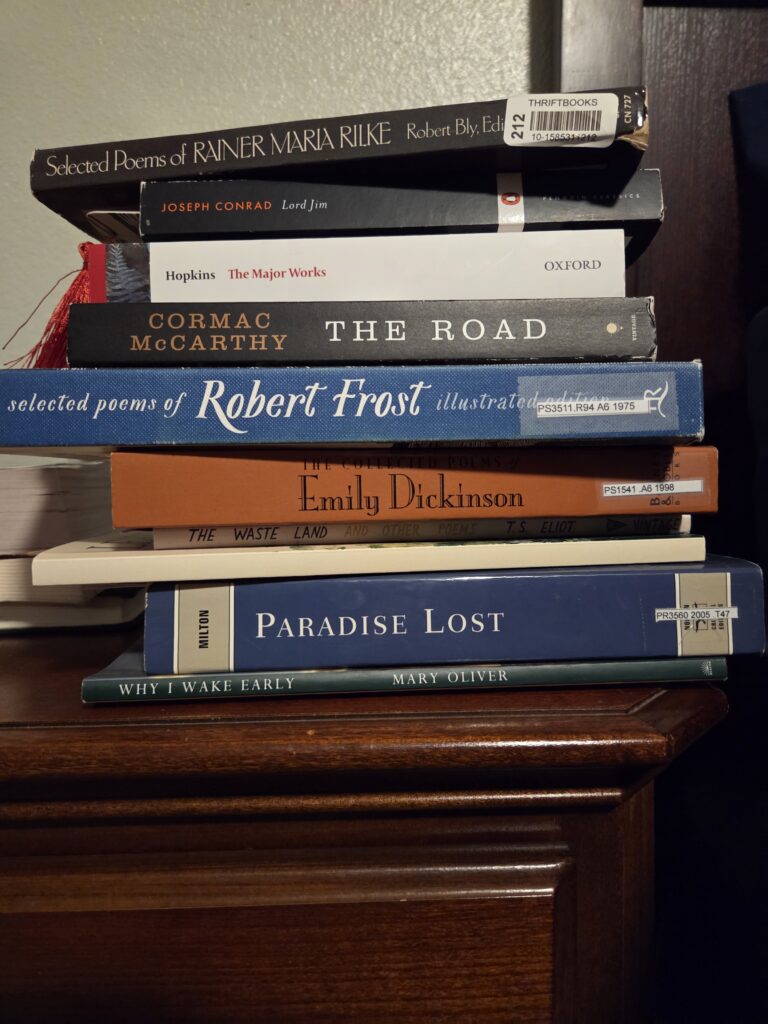
There was some time after dropping the kids off at school for me to get away. Kristin was at the salon, getting her hair cut and perpetuating the lie that is her hair color. She would still be there when our youngest got out of school and so I needed to pick my youngest up. Between dropping off Kristin and waiting to pick up my youngest, I had two hours. I made my way to Vim and Vigor in Manette with my stack of books.
I like that shop. They’ve got good seating and a great selection of vittles. I ordered an eight ounce decaf cappuccino, a Probiotic Lemonade from Pressed Juicery, and a Marionberry Pastry. The shop isn’t too loud: the music plays lightly and there is the faint hum of small dramas unfolding all around me.
When I first arrived a group of three sat next to me—older, all three over the age of 60, a couple and a walk-in that came over to chat. While they were talking a grandmother with her granddaughter came in, and the grandmother was dismayed that there were no spots for them. I offered my seat, which the grandmother rejected, trying to minimize her need. As soon as she did, the entire coffee shop turned to her and one by one they all offered her their seats. The three beside me said goodbye and the walk-in left, giving them the seat.
Lots of interesting interruptions like this to punctuate my study.
The books were jumbled in the bag when I pulled them out, so the stack was randomized. I kind of love it, something new. I’m tempted to throw them into the air every morning, watching them tumble to the floor, and pick them up at random to get some diversity while I memorize poetry. I wonder if my sleeping family will mind?
I began with Whitman. I’m memorizing a newer, extended portion of a section I memorized years ago. Throughout his life he expanded on this work, and the newer version has considerable additions. It is an odd mix of difficult, new poetry and old, familiar lines. My fatigue made it more difficult than normal.
This section, I’m more and more convinced, is using imagery of the Garden of Eden to paint what Whitman is doing as a return to original humanity.
He contrasts the fragrance with the atmosphere. The fragrance is man-made. It is artificial and is found in human places. But Whitman is not going to be tricked by this artificial air. Though the fragrance could intoxicate him, he doesn’t let it.
However, the atmosphere doesn’t have a trace of this fragrance and it is something Whitman claims he wants to get naked in because he is mad for it to be in contact with him. Nudity in the woods feels like a veiled reference back to the Garden.
The contrast between the fragrance inside the shop and the atmosphere just outside the front door stood out to me. I wondered what it meant for my life, as though maybe there was a metaphor for the places I like to inhabit (maybe in my attitudes or patterns of thinking) and how those places might be constructed by our culture, by the crowd, and may be artificial constructs of the crowd. Sertillanges and Kierkegaard say the crowd is untruth, and often I wonder if I am thinking in the artificial, malformed manner of the crowd. How close am I to something true?
Back to the text, Whitman’s language of human made fragrance contrasting with natural language and nudity feels like a contrast between the attitudes of the modern man of Whitman’s time and their obsession with the up and coming technological era of the Industrial Revolution and his own self espoused prophetic outlook. Whitman seems to mock religious symbols and modern man at the same time, claiming to be something greater. He seems to take on the title of Jesus, a new Adam, and does so in a strictly American way.
I think I need to read critical essays on this book to make sure I’m picking up on the undertones Whitman is broadcasting. He’s an extremely talented writer and there’s a lot behind his words. I’m not confident in anything I think about him.
From Milton I am memorizing lines 17-26 of Book 1. Milton is bold. The intro of his magnum opus is asking God to aid him in his “advent’rous song” which he wants to be greater than classical literature while it attempts “things unattempted yet in prose or rhyme.” He asks God, in regard to this goal, to instruct him, keep him humble, and to illumine the dark parts and and to elevate what is low in his soul. His argument in the prayer is that his goal is to assert God’s “Eternal Providence” and to “justify the ways of God to men.” Because of that, he believes God will guide him.
It seems bold, but Milton was a genius. He rides the line of humility by not denigrating what God has given him while trying to push his potential to the full potential, all while admitting his limitations and acknowledging all his talents comes from God.
Sometimes I think we need to lean into our gifts and use them without guilt, acknowledging that they are gifts from God himself. It isn’t pride for Milton to be ambitious in the way God gifted him to be, but it’s also hubris for Milton to claim it is all of himself. There is a balance.
From Oliver I’m finishing memorizing her poem Bone. There’s a particular part that stands out. She says:
Beside me
the gray sea
was opening and shutting its wave-doors
unfolding over and over
its time-ridiculing roar;
I looked but I couldn’t see anything
through its dark-knit glare;
yet don’t we all know, the golden sand
is there at the bottom,
though our eyes have never seen it,
nor can our hands ever catch it
lest we would sift it down
into fractions, and facts—
and what the soul is, also
I believe I will never quite know.
For Oliver, though we can’t see the soul, it doesn’t mean we don’t know it’s there and can’t know anything about it. And maybe we aren’t allowed to see it because we would ruin it, making it ever more quantitative and dissecting it from the whole of human life. She ends the poem saying she doesn’t think her place is to know but to live her life in love, in the real world, embodying her life in the fullness of her soul and letting it seep out into the fabric of the world.
Sometimes I feel this way about some of the nuances of Systematic Theology. We silo off these doctrines, sifting them from the whole, and divorce our way of thinking from the love we are called to walk in with God.
Once again, pivoting off of Milton, humility is key. What is our place in the grand scheme of things and are we prepared to accept it? For example, in theology, is it possible to allow mysteries to rest and believe them just because the Bible says so, without need to explain them?
It is interesting, though, that Milton tries to give voice to the unspeakable, to elevate it, while Oliver seems to shy from these mysteries, wondering if they are best left as is. I’m unsure how to think about this, but something to contemplate.
McCarthy’s quote is something I found aesthetically pleasing, and that was originally why I wanted to memorize it. A lot of the times I’m drawn to lines just because they’re beautiful.
“He got the binoculars out of the cart and stood in the road and glassed the plain down there where the shape of a city stood in the grayness like a charcoal drawing sketched across the waste.”
The shape of a city. Profound. A city is not a collection of buildings, but a collection of people in buildings and without people the collection of buildings is only the shape of a city. Like a soul to a body, people are to a city, and without people a city is just a charcoal drawing sketched across the waste. I need to think about this more.
I began working on Ghost House by Robert Frost. The imagery is great. The way he describes the lapse of time is fantastic. I’m too tired to really understand it, but my curiosity is piqued and I definitely want to figure out the depths of this poem.
Finished day 10 on an Emily Dickinson poem. How does she cover all of life in one poem? Deceptively simple.
Our share of night to bear—
Our share of morning—
Our blank in bliss to fill
Our blank in scorning—
Here a star, and there a star,
Some lose their way.
Here a mist, and there a mist,
Afterwards — day!
Emily grows on me more and more every day.
The Italian epigraph of The Love Song of J. Alfred Prufrock, pulled from Dante’s Inferno, is difficult because I didn’t memorize an English translation of this section from Dante’s Inferno before memorizing the Italian. This will be important when memorizing the German poetry of Rilke. I see now I need to memorize the English version of Rilke before memorizing the German version so my brain can make sense of the input. The Italian is beautiful but I can’t understand it. Memorizing tones without meaning is kind of insane. It is working, but it is slow. Kind of like music. I plan on memorizing an English translation after getting the Italian down so I can mull it over for a while and maybe dig into what it means on a more nuanced level.
Isn’t it strange, memorizing tones (pleasing sounds) without having a clue as to what they mean? Back to the automatic impulses of the crowd, do we even know why we live the way we live? Are we living in pleasing rhythms of life without any knowledge of the why behind?
The bit I chose from Joseph Conrad’s work Lord Jim was too ambitious. There is no way to memorize it in 10 days. I need to be more selective and less ambitious in my selections. Prose is easier to find long sections from and think that I can memorize them. I’m getting a better feel for my limits.
I began the first poem in Rilke’s collection From A Book for the Hours of Prayer. The English translation is still copyrighted, so I can’t post it here. I spent time getting familiar with it. After memorizing the English I plan to memorize the German, which is on the other side of the page in my book. I’ll keep you updated on this poem and write more about it later.