A memory sticks much better as an image in your head, and even better as two images, or a poem and an image, or a poem, a song, and an image. The more ways you can create a sticky environment for a memory, the better the memory will stick. Acrostics and Fictional Characters are a few ways I’ve found to do that.
I’d like to begin to show you how you can build complicated memory networks that can sink abstract information deep inside your head. First, I’d like to take time in this post to show you how I’ve memorized a specific philosophical concept within the philosophy of beauty, and then in subsequent posts we can dig into my actual process for memorizing the entire book Biblical Eldership by Alexander Stauch, in real time.
Let’s begin with acrostics. An acrostic is a poem or other word composition in which the first letter of each new line spells a word. It’s a lot like an acronym, but it is different. Acronyms condense titles, like FBI stands for Federal Bureau of Investigation, but an acrostic doesn’t condense a name at all. Instead, it strings together unrelated lines of information into a word.
Here’s an example of an acrostic I developed to remember chapter one of Beauty: A Very Short Introduction by Roger Scruton. First, here’s my basic, 10,000 foot outline of the chapter.
- Section 1: The Core Problem of Defining Beauty
- Section 2: Classical Ideals vs. Subversive Reality
- Section 3: The Six Platitudes
- Section 4: The Central Paradox of Aesthetic Judgement
- Section 5: Types and Degrees of Beauty
- Section 6: The Nature of Aesthetic Interest
- Section 7: Sensation vs. Intellect
- Section 8: Kant’s Theory (Disinterest and Objectivity)
After playing with these sections for a while and rearranging them with AI, I came up with the acrostic BEAUTIFUL.
B – Baseline Platitudes: Any philosophical theory of beauty must be tested against six fundamental, everyday truths.
E – Ends, Not Means: We appreciate a beautiful object as an end in itself, completely independent of its practical utility.
A – Agreement (Suitors for): Following Kant, when we make a judgement of beauty, we act as “suitors for agreement,” presenting our verdict not as a private opinion, but as one we expect other rational beings to share.
U – Undefinable Property: Beauty is not a simple physical property like shape or size, as it expands across nearly every ontological category.
T – Types and Degrees: Beauty is comparative, ranging from the minimal harmony of a tidy street to the supreme, breathtaking appeal of a masterpiece.
I – Intellect over Sensation: True aesthetic pleasure engages the mind and imagination, which is why purely sensory experiences like smells and tastes are generally excluded.
F – Friction with Virtue: Beauty can be deeply subversive, sometimes acting as the enemy of both truth and goodness by making myths credible or vice alluring.
U – Uncompelled Reasons: The central paradox is that while judgements of taste rely on critical reasons, those reasons can never form a deductive argument that absolutely compels someone to agree.
L – Limits of Substitution: Because aesthetic interest is in the specific individual object, it cannot be satisfied by a functionally equivalent substitute.
I won’t break down how I memorized every single one of these letters today, but let’s zoom in on the ‘B’ get a taste for how to go deep into a concept.
Next, I created a character that would run around my BEAUTIFUL layer. Acrostics help you remember, but converting anything into a mnemonic image is always better for remembering. Like I said, two ways to remember something are much better than one. I decided to create a Victorian style woman who portrayed that classic muse ideal. Think “the artist’s reasons for existence and inspiration for his artwork. You know… that old trope. Here she is.

Before we build an image for the B of the acrostic BEAUTIFUL, we need to ask ourselves if we have hit the bottom of the idea or if there are ideas below. For B, it is obvious that there are at least 6 ideas below that B, since there are six fundamental truths any theory of beauty must be measured against. What are those six fundamental truths? So, I went down into the baseline platitudes (the B in BEAUTIFUL) and built another acrostic that would outline those truths. This one is FACTOR, which tells me what the six baseline platitudes are.
F – First-hand: There are no second-hand judgements of beauty.
A – Attention: Beauty is always a reason for attending to the thing that possesses it.
C – Comparative: One thing can be more beautiful than another.
T – Taste: Beauty is the subject-matter of a judgement: the judgement of taste.
O – Object-focused: The judgement of taste is about the beautiful object, not about the subject’s state of mind. In describing an object as beautiful, you are describing it, not yourself.
R – Rewarding: Beauty pleases us.
For FACTOR I need another character, since every acrostic has its own character. I thought of Fear Factor with Joe Rogan, who is now the character I have running around on my FACTOR level.
To bridge down from the B of BEAUTIFUL to the F of FACTOR, I create an image which shows both characters that are tied to both acrostics. In this case the Classic Muse Woman and Joe Rogan. If I see two characters that always means that I have more information below this point.
But beyond remembering that FACTOR below the B, I needed to recall a few pieces of information.
- The phrase “Baseline Platitudes”
- That these platitudes can be used to test philosophical theories of beauty.
- That there are six of these platitudes.
- That the platitudes are located on the FACTOR layer.
Here’s the image Gemini and I came up with.
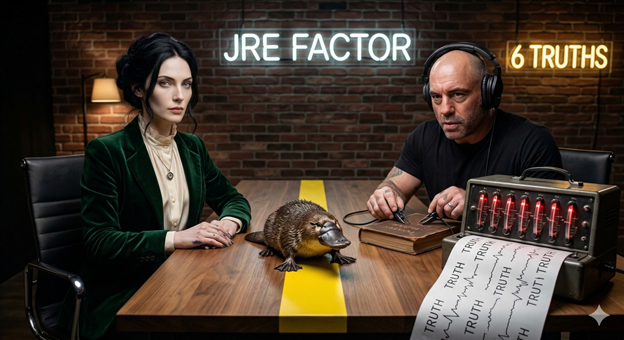
Let’s look over the details.
First, we have a giant line that reminds me of the word Baseline. On the line is a platypus, which triggers platitudes. Baseline Platitudes… easy. Now I’ve got Joe Rogan “testing” a book of theories, looking to see if they are compliant. There are six tests it is conducting. So, this reminds me that any theory of beauty must conform to 6 everyday truths. Last, in the upper right corner I see a big sign that says 6 truths, to remind me again that there are 6 truths to remember.
Now, from here, because I see two people, I know I have to go down a layer. In this case I have to leave the BEAUTIFUL layer and go to the FACTOR layer. Below are my images for FACTOR. I’ll give brief explanations of what they mean.
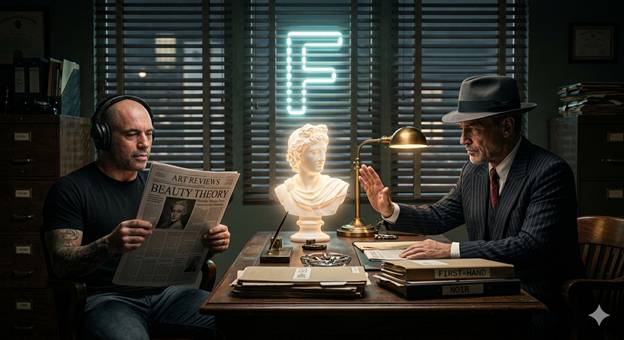
F – First-hand: There are no second-hand judgements of beauty.
Joe Rogan gives a second-hand account of a theory on the beauty of an artifact now in the possession of by the detective in the image (the glowing bust), but the detective puts his hand up and stops Joe. Why would he listen to Joe’s report if he can just observe the artifact first-hand?
Notice how there is yet another character in this picture. This means that there is another layer below the F in the FACTOR layer that I need to remember. I won’t share that here, but it is another acrostic that explains what First-hand means in more detail.
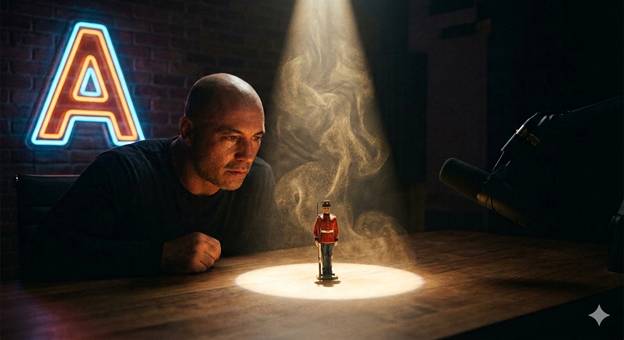
A – Attention: Beauty is always a reason for attending to the thing that possesses it.
Joe Rogan pays extreme attention to a little toy soldier that is standing at attention. For some reason, the beauty of the toy makes him weep.
Notice here how Joe Rogan is alone. This means that this is the bottom of the line. There is no acrostic below the A of FACTOR and so I can move onto the next letter in the acrostic.
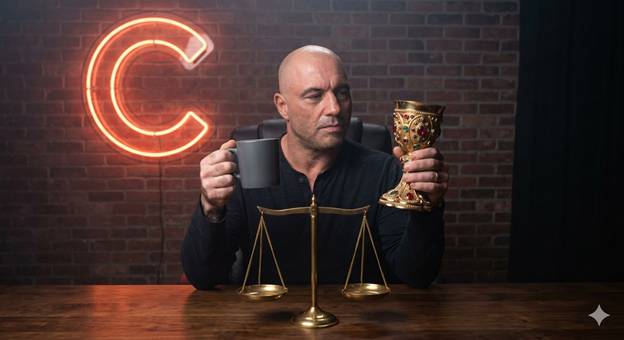
C – Comparative: One thing can be more beautiful than another.
For this one, I had to remember the difference between harmony and ideals of beauty. Often, we think of perfect beauty when we talk about philosophical theories of beauty, but these ideals often don’t work in real life. For example, would I rather have a gold, jewel encrusted goblet for a coffee mug at the office, or a normal coffee mug? For me, the gold goblet would be less ideal than the coffee mug because the coffee mug would be in harmony with the rest of the stuff present. Comparisons are always made from objects that are the same kind of object as well as objects to the environment they will inhabit.
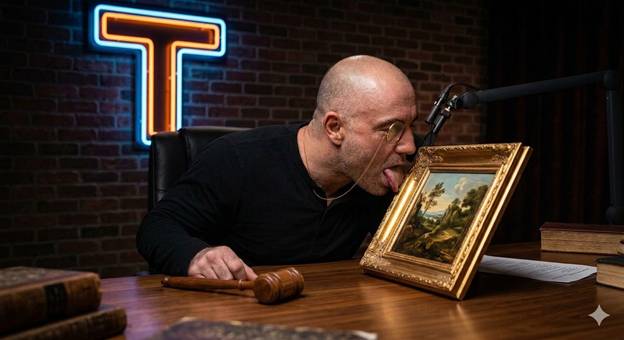
T – Taste: Beauty is the subject-matter of a judgement: the judgement of taste.
In the philosophy of beauty, taste is objective. It isn’t like the preference between vanilla and chocolate, but more like the taste of a burnt dish versus a perfectly cooked one. We must judge the reality of an object and use our taste of beauty to evaluate it as it really is. Joe literally licks the picture to evaluate it, while having a monocle on. This one sticks in my head well.
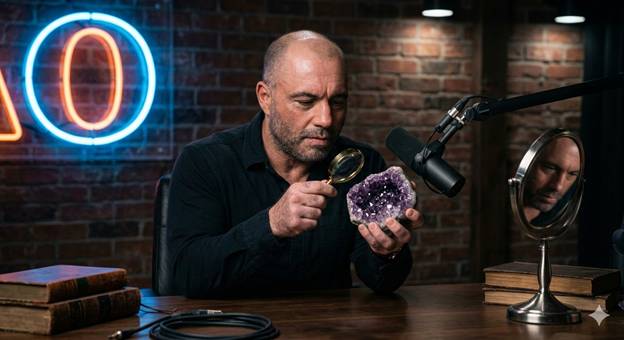
O – Object-focused: The judgement of taste is about the beautiful object, not about the subject’s state of mind. In describing an object as beautiful, you are describing it, not yourself.
Joe wonders if the object is real or if it is from aliens. He looks closely at the object itself to look for clues. This reminds me that beauty is experienced from the object, not as a subjective experience. We are pulled toward the object BECAUSE it is beautiful.
R – Rewarding: Beauty pleases us.
Joe ignores a million-dollar deal on his phone because of how rewarding the beautiful object is on his desk.

Now, when I’m done exploring the FACTOR layer, I’ll go back up to the BEAUTIFUL layer and move to the E, going down that branch and seeing the image in my mind, converting the information into words I can use to speak these ideas in real time.
This gives a baseline view. To recap, here are the key takeaways.
- Outline a piece of information you want to remember into its baselevel parts.
- Create an acrostic that helps you remember that information.
- Once you have an acrostic, create a character that represents that acrostic.
- Before creating an image to help you remember the points of the acrostic as images, see if there is more information below the concept you are working on. If there is, outline that idea, create an acrostic for it, and create another character to represent that acrostic.
- To build a bridge from one acrostic to another, show those characters inside of an image.
- In the same image, encode all the information you want to remember as physical symbols you can see.
- Follow the line of thought all the way through, recall what the symbols mean, and you will be able to remember every detail you want to from whatever it is you are trying to remember.
In my next post I’m going to show you how I use Google Slides to keep track of these networks. Then I’ll give an example of how I layer stories to remember acrostics even better. Finally, in the following posts, I’ll show you how I use Anki to deepen the memories and to ensure I never forget them. After this, all the groundwork will be done, and we can begin the actual process of encoding the book Biblical Eldership.